
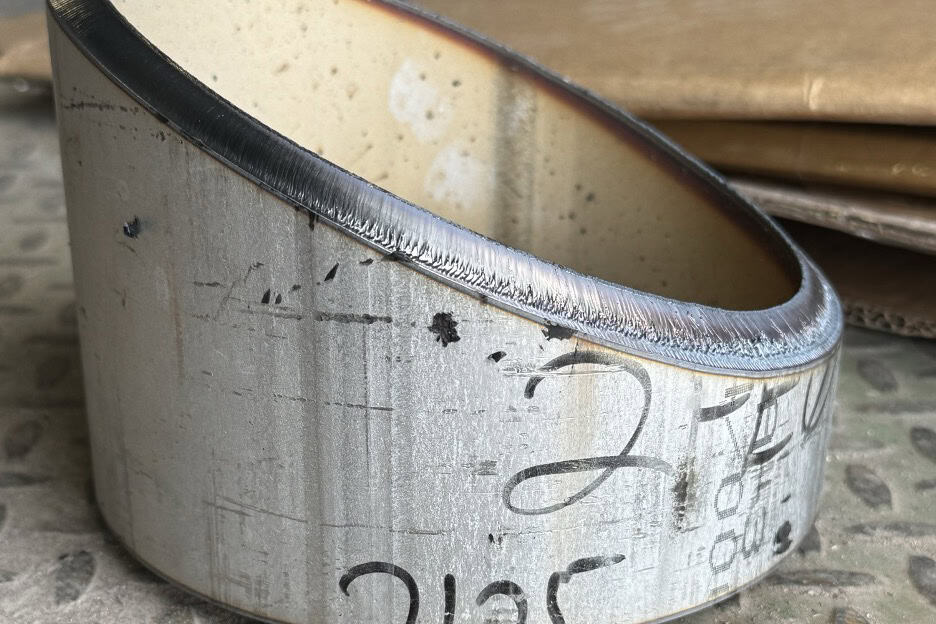
When shops start shopping for a CNC cutting system, the assumption is usually the same: if you want a clean cut, you buy a laser. Fiber laser marketing has been loud for a decade, and on thin material, it has earned the attention.
But most pipe and tube work is not thin material. It is 6-inch schedule 40, 8×8 structural tube, heavy channel, and angle. Somewhere between light sheet and heavy structural, the laser’s advantage quietly disappears, first on cost, then on speed, and eventually on edge quality too.
Here is where that line actually falls, and how to tell which side of it your shop is on.
Why This Comparison Matters
Choosing a cutting process is not just a cut-quality decision. It sets your cost per part, your material purchasing, your maintenance burden, and how much secondary work lands on your floor.
Picking the wrong one does not usually show up as bad parts. It shows up as a machine that costs two to five times more than it needed to, cutting material it was never optimized for.
1. Know Where Laser Actually Wins
Fiber laser is a strong technology, and it is the right answer for a real set of applications. If your work looks like this, buy the laser:
- Material under about 1/2 inch
- Small holes and tight features that need a narrow kerf
- Tube under about 1 inch in diameter
- Parts that go straight to a machined mating surface with no weld
On that work, laser is faster, cheaper per foot, and holds tighter tolerances. Nobody at Pipe Dream is going to argue otherwise.
The problem is that most shops never check whether that actually describes their parts.
2. Understand the 1/2-Inch Crossover
Thermal cutting economics flip on thickness, and the flip point is well documented. Hypertherm and the American Welding Society’s Welding Digest put it in the same place: roughly 12 to 16 mm, or 1/2 to 5/8 inch.
Below that, laser is cheaper per foot of cut. Above it, plasma is. And above roughly 5/8 inch, plasma is also the faster process outright.
That is not a plasma vendor’s talking point. It is the difference between pushing photons through a thick section and pushing a 20,000-degree arc through it.
3. Compare Cut Quality Honestly
The real comparison is not laser-clean versus plasma-rough. On modern high-definition plasma, the dimensional difference between the two processes is about 0.010 inc, roughly the thickness of a business card.
Then consider what happens as material gets thicker. AWS notes that fiber laser edges pick up significant dross and oxide on material over 1/2 inch, which is exactly the range where high-definition plasma edges stay clean and consistent.
So on heavy wall, the edge-quality argument does not just narrow. It can reverse.
Shop Floor Tip
Before comparing spec sheets, look at where your cut edges actually go. If most of them get welded, ask what 0.010 inch is worth on a joint with a 1/16-inch root gap. On a saddle cut, a handrail post, a trailer frame, or a structural connection, the weld absorbs that difference entirely.
4. Run the Real Cost Numbers
Capital is the headline. A fiber laser system runs two to five times the price of a comparable plasma system, and plasma systems commonly reach ROI in two years or less.
The operating side is where thick-material shops feel it every day:
- Assist gas. High-power laser cutting on thick material burns significant gas volume; plasma consumption on heavy sections is lower.
- Consumables. Plasma consumables are inexpensive, stocked, and changed by your operator in minutes.
- Maintenance. A laser’s cutting head and motion control are complex and often require an authorized service center. Plasma is maintainable in-house.
- Shop environment. Fiber lasers are sensitive to dust and need regular cleaning. Plasma tolerates a working fab shop.
- Material grade. Laser wants clean, laser-grade stock. Plasma cuts rusty, mill-scaled, painted, or coated material as it arrives.
That last one is the sleeper cost. Structural pipe and tube show up with mill scale and surface rust; that is simply what the material is. If you have to buy premium stock or pre-clean it to feed a laser, that premium is on every part you ever run.
5. Don’t Overlook Bevel
If you are cutting pipe, you are almost certainly beveling pipe. Weld prep on heavy wall is not an accessory. It is the job.
This is where the laser conversation gets expensive quickly. Bevel capability on a tube laser sits at the top of the product line and pushes an already large capital number substantially higher.
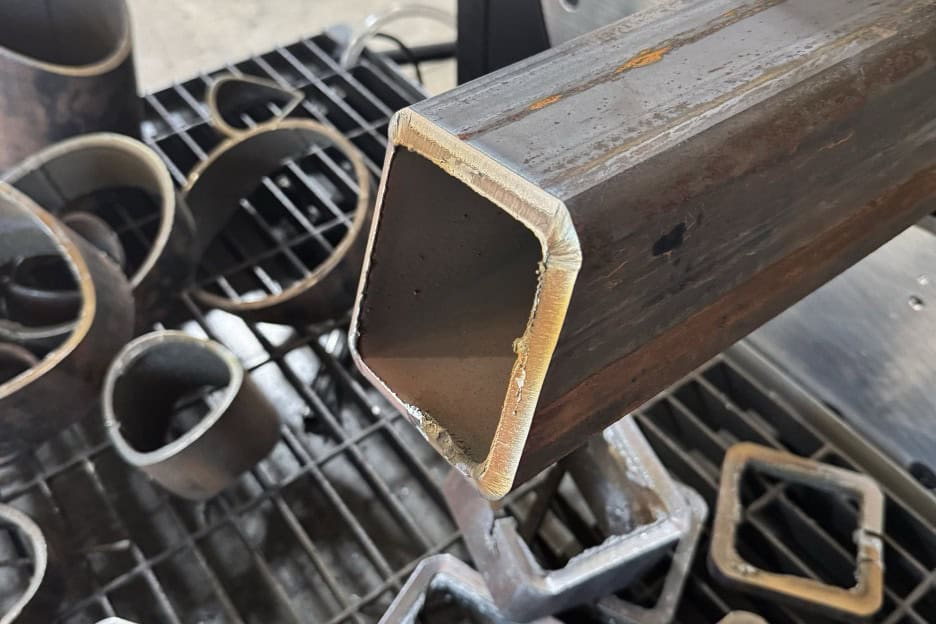
On plasma, automated beveling is mature and accessible. The PD-10 cuts, bevels, and engraves in the same setup on round, square, rectangular, angle, and channel up to 10 x 10 inches and 800 pounds.
A part that comes off the machine already beveled does not go to a grinder, does not sit in a queue, and does not burn a second setup. On heavy-wall work, that saved labor routinely outweighs any difference in cut-edge finish.
Side-by-Side Comparison
| Fiber Laser | High-Definition Plasma | |
| Best thickness range | Under about 1/2 in. | Full range; clear edge over 5/8 in. |
| Speed on heavy wall | Slows sharply with thickness | Faster than laser above 5/8 in. |
| Cut quality (ISO 9013) | Range 1-2 | Range 2-4; Range 2-3 on HD systems |
| Dimensional difference | Baseline | About 0.010 in. |
| Edge on thick material | Dross and oxide over 1/2 in. | Stays clean and consistent |
| Rusty or coated stock | Needs clean, laser-grade material | Cuts it as-is |
| Capital cost | 2 to 5 times plasma | Baseline; ROI often under 2 years |
| Maintenance | Complex; authorized service | In-house, operator level |
| Small features and tube | Clear advantage | Practical limit around 1 in. dia. |
How to Decide for Your Shop
Skip the brochures and run your own parts through three questions.
- What is my typical wall thickness? If most of your work is over 1/2 inch, the economics already favor plasma.
- What happens to the cut edge next? If it gets welded, you may be paying for precision the joint will absorb.
- What does my material look like when it arrives? If it comes in with scale and rust, a process that requires clean stock is a recurring cost, not a one-time purchase.
Answer those honestly, and most pipe and tube shops land in the same place.
Final Thoughts
Laser is not overrated. It is over-applied.
It is a precision instrument frequently sold into heavy structural work, where its advantages are largely absorbed by the weld that follows and its costs compound on every part.
On large-diameter, heavy-wall pipe and structural tube, high-definition plasma delivers a cut that is functionally equal for the large majority of applications, at a fraction of the acquisition cost and a lower cost per foot. That is not settling. That is matching the tool to the work.
Ready to See the PD-10 in Action?
See how automated pipe cutting, beveling, and integrated CNC controls can help your shop cut heavy material cleanly without a laser-sized investment. Send us a print, and we will show you what your parts look like off our machine.
Sources: Hypertherm, “Plasma Cutting vs. Fiber Laser Cutting” and “How to Choose Between Laser and Plasma Cutting”; American Welding Society Welding Digest, “Fiber Laser Cutting vs. Plasma Cutting in Metal Fabrication” (May 2024); BLM Group, “The differences between laser and plasma in tube cutting.”