
Every CNC tube cutter on the market publishes the same numbers. Rapid speed. Positioning resolution. Max diameter. Max length. Motor wattage.
Nobody publishes the one number that decides how much work actually leaves your shop: how long it takes to go from the part you just finished to the part you need next.
We’ve watched changeovers on gantry-over machines take anywhere from 20 minutes on a good day to two full hours when the job goes from 2″ round to 4″ square. That’s not a knock on the operator. It’s not a maintenance issue. It’s the architecture doing exactly what the architecture requires.
Here’s what’s actually happening, and why the PD-10 doesn’t have that problem.
The geometry problem gantry-over machines can’t get around
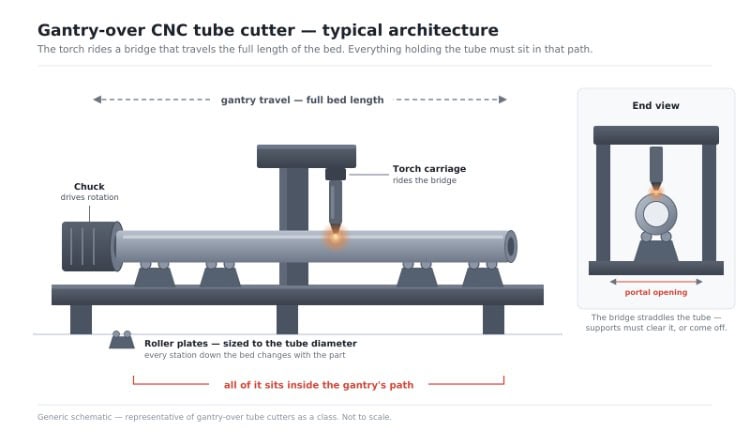
On a gantry-over cutter, the torch rides on a bridge that travels the full length of the bed, passing over the material as it cuts. The part itself is driven by a chuck at one end and has to be held on the machine’s centerline for the entire span behind it.
That creates a hard constraint: everything holding the tube up has to live in the gantry’s path. Supports, rollers, stabilizers, back stops — all of it sits between the chuck and the far end of a bed that might be 24, 42, or 50 feet long, and all of it has to clear a bridge that’s about to drive right through that space.
So the tooling has to be low, it has to be size-specific, and it has to come off and go back on every time the material changes.
That’s not a design flaw. If you build a machine that way, that’s the price of admission. But it’s a price that gets paid on every single job change, by a person, on the clock.
What that looks like in practice
Look at what ships with one of these machines and you’ll find some version of the same list: an array of roller plates, a pair of flat tooling plates, adjustable back stops, a gantry-mounted stabilizer, a material lifter or two, and a self-centering chuck. To use one concrete example, that’s the standard tooling package published on the product page for the JD Squared XR12 — and the pattern holds across the category, because the geometry is what forces it.
Read that list again with a stopwatch in your hand.
An array of roller plates. An array, because the plates are diameter-specific — that’s the only way a roller can hold a round part on centerline. Round 2″ doesn’t sit on the same plate as round 6″. There is no universal plate — a fixed V can only cradle one diameter on centerline, so a different diameter needs a different plate. Change size, change plates. And on a 24-foot bed, you’re not changing one; you’re changing every station down the length of the part.
Flat tooling plates with adjustable back stops. Round parts rotate on rollers. Flat and non-rotating parts sit on plates against stops. Those are two entirely different setups. Going from one to the other means pulling one out of the gantry path, installing the other, and re-setting the stops.
A stabilizer — singular, chosen by profile. Round tube needs the round stabilizer. Square and rectangular need the square stabilizer and its gauge kit. Angle needs the angle stabilizer. They’re sold as separate add-on kits running from a couple hundred dollars to several thousand. If your shop runs all three profiles, you buy all three, you store all three, and you swap the head-mounted stabilizer every time the profile changes.
And then — the part everybody forgets when they’re estimating changeover — you have to prove it’s centered again.
That’s the whole purpose of all that tooling: holding the part’s axis on the machine’s axis. Every time you break the setup down and rebuild it, you’re re-establishing that relationship by hand. Get it wrong, and the machine won’t tell you. You find out at the weld table, on a part you already cut fifty of.
Now do it with a couple thousand pounds of stock on the bed and a helper on the other end of the plates.
Twenty minutes to two hours. That range isn’t sloppiness. That’s the honest spread between “same profile, one size up” and “round to square, full teardown.”
The cost you can’t see on the timecard
Lost hours are the obvious cost. They aren’t the expensive one.
The expensive one is what a painful changeover does to how you schedule. Shops running gantry-over machines learn fast that the way to avoid the teardown is to avoid changing over — so they batch. Every 2″ job in the building gets held until there’s enough 2″ work to justify the setup.
Which means:
- Work in process piles up. Parts sit staged, waiting on a batch that hasn’t filled yet.
- A hot job waits on a cold one. The customer who needs eleven parts in 3″ round is stuck behind a queue that has nothing to do with him.
- One-offs and prototypes stop penciling. When setup is two hours, and the run is six parts, you either eat it, or you quote it high enough that you don’t win it. Either way, that’s the work that would have led to the production order.
- Your lead times get quoted around your setup, not your capacity. You’re not selling machine hours anymore. You’re selling batch slots.
That’s the real bill. The machine isn’t slow. The machine is fine. The tooling change is setting your throughput, and it’s doing it invisibly, inside your scheduling decisions, where it never shows up as a line item.
How the PD-10 gets out of it
The PD-10 started from a different question: not “how do we support the tube under the gantry,” but “why is the torch the thing that moves?”
On the PD-10, the cutting station is fixed. Two chucks hold the stock — both self-centering, both driven — and the rear chuck travels forward, feeding material through the stationary front chuck and past the torch. The part moves. The tooling stays put.
That one inversion deletes the constraint the entire gantry-over category is built around. Nothing has to clear a traveling bridge, because there is no traveling bridge.
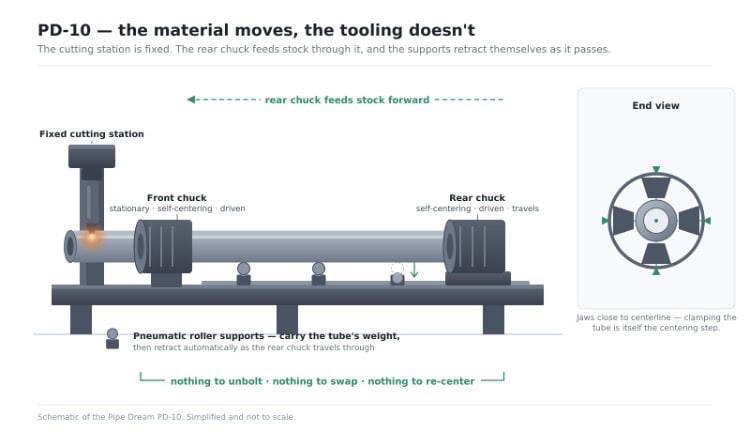
The chucks do the centering. Both are self-centering, so closing them on the material is the centering operation. There’s no manual adjustment, nothing to indicate, nothing to verify afterward. You tighten, and you’re cutting.
The rollers are universal. Between the chucks, the tube’s weight rides on a pneumatic roller system — and that system is the same one whether you’re running 1″ round or 10″ square. Round, square, rectangular, angle, channel: same rollers, no size-matched plates, nothing to own, nothing to store, nothing to swap. Compare that to a bed full of diameter-specific plates where every size in your rack needs its own set.
And they get out of the way by themselves. As the rear chuck travels forward, each roller retracts automatically as the chuck reaches it. Nobody lifts anything. Nobody unbolts anything. It isn’t a faster version of the manual step — it’s the removal of the manual step.
So the changeover on a PD-10 is:
- Open the chucks. Pull the remnant.
- Load the next stock and tighten the chucks — that’s the centering, done.
- Load the next program and cut.
No plates to unbolt. No roller sets to pull and re-stage down the length of the bed. No stabilizer to swap because the profile went from round to square. No back stops to re-adjust. No re-establishing the centerline, because you never broke it in the first place.
That’s the entire difference, and it isn’t a software feature or a faster motor — it’s the machine architecture. A machine that never puts tooling in the torch’s path doesn’t have to take tooling out of the torch’s path. Mixed profiles, several job changes a day, short runs — that’s exactly the shop where changeover is quietly eating the week, and it’s the shop the PD-10 was built for.
Run the number for your own shop
You don’t need our math. You need yours. But here’s the shape of it:
| Changeovers per day | 3 |
| Average changeover (mid-range of what we’ve observed) | 40 min |
| Lost machine time per day | 2.0 hrs |
| Lost per week (5 days) | 10 hrs |
| Lost per year (50 weeks) | 500 hrs |
Five hundred hours is twelve and a half working weeks of machine time — three months a year where the gantry is parked, and somebody is moving plates.
Put your own shop rate against it. At $125/hour of billable machine time, that’s $62,500 a year. At $150, it’s $75,000. Against a machine in the $80,000 class, the changeover costs more than the machine did — every year, forever.
And that’s the optimistic version, because it only counts the clock. It doesn’t count the jobs you never quoted.
What to ask on your next demo
Whoever you’re evaluating — us included — make them show you this, not tell you:
- “Cut me a part in 2″ round. Now cut me one in 4″ square. Start the clock at the end of the first cut and stop it at the start of the second.” Don’t accept a spec-sheet answer. Watch it happen.
- “How many people does that take?” One operator or two matters a lot at 24 feet.
- “What tooling do I have to buy to run every profile I run?” Get the stabilizer, roller, and plate kits priced into the quote, not after it.
- “How do I know it’s still centered when you’re done?” If the answer involves a tape measure and a good eye, that’s your scrap rate talking.
- “Where does that tooling live when it’s not on the machine?” Floor space is money too.
Ask us the same five questions. We built the PD-10 specifically so the answers would be short.
Pipe Dream CNC designs, machines, fabricates, assembles, and tests every machine in Spokane, Washington. If you want to see a changeover run against a stopwatch instead of a brochure, we do live one-on-one demos.
(503) 347-9620 · pipedreamcnc.com
The tooling package described above is taken from the manufacturer’s own published product page as of September 2026 and is accurate to the best of our knowledge; specifications change, so verify current details with the manufacturer. Changeover times cited here reflect our own direct observation in working shops and will vary with operator, part size, and the size of the profile change. Run the stopwatch yourself — on our machine and on anyone else’s.